Ready to purchase barcode printers for your business? If you are new to printers, here is a brief explainer on the different types of label printers available for you. It’s important to consult with an expert like CSSI to ensure you are ultimately choosing the right model.
Print Process – Thermal Transfer or Direct Thermal?
When it comes to selecting an industrial label printer, the first thing is to understand the best type of print process for your application. Typically, you will choose between a direct thermal label printer or thermal transfer label printer. In specialty cases where color labels are necessary, you may do best with color inkjet . Once you know the print process you wish to use, you can select the best class of printer for you.
Thermal printing uses heat to apply the content to the print labels. A direct thermal printer applies the content directly to the label material. A thermal transfer label printer utilizes a print ribbon as an intermediary to transfer content to the label. To learn more about the pros and cons of each printing technology, see our prior article about Thermal transfer printers vs direct thermal printers.
Classes of Barcode Label Printers
There are several different label printer classes or categories. The correct category for your business will depend upon the usage environment, label requirements, and print speed, in addition to the level of ruggedness which is necessary.
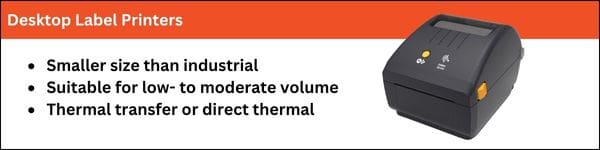
1. Desktop label printers
Desktop printers are a bread-and-butter choice. These are durable and business-ready printers, typically available in either 4 inch or 6-inch label widths. Direct thermal and thermal transfer printer models are available. Typical print speeds run around 6 ips (inches per second), making this a good choice for applications where volume is high, but not extremely high. Desktop printers are smaller than industrial printers, so it’s easier to find space for them.
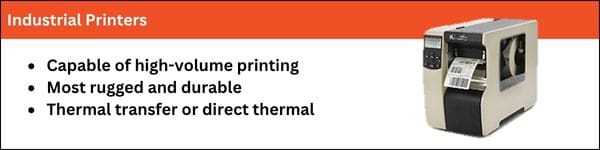
2. Industrial label printers
An industrial label printer serves in harsh and demanding use environments such as production floors, where the industrial printer must be able to withstand dust and particles, as well as high use. Industrial printers may run as fast as 12 or 14 ips (inches per second), making this a necessary choice for high-volume label generation. Options are available in thermal transfer and direct thermal, although thermal transfer is more common. Some industrial label printers offer a label verifier, which can confirm that each label generated has a readable barcode. This is necessary for applications where non-readable labels are not acceptable (for example, the company may be hit with chargebacks from larger retails for non-conforming labels). Industrial printers require more desk or counter space, so take that into consideration.
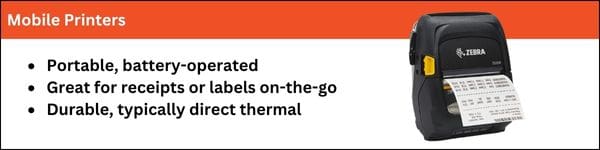
3. Mobile printers for labels and receipts
Do you need to generate labels or receipts while on the go? Then a mobile label printer is the best choice. These are smaller, battery-powered printers, typically employing a direct thermal process. The focus is on mobility and relatively light weight. Most mobile printers use a direct thermal printing process, but we have specialty printed label materials which allow you achieve thermal transfer results from a direct thermal printer.
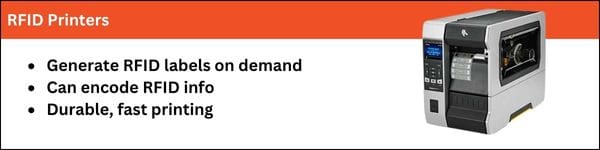
4. RFID printers
RFID printers have the ability to encode RFID tags as well as print labels. These printers are necessary if you are printing unique RFID labels at the point of use. We can work with you on your RFID process and pair you with the right printer.
5. Color Inkjet
If you are printing labels which require high-resolution graphics (retail labels, packaging labels), then the right choice may be a color inkjet printer. CSSI offers several color label printer choices and can help you with your selection and testing.
Need Help with Barcode Labels & Print Supplies?
CSSI offers years of experience in the specification and procurement of reliable and cost-effective label media solutions and print supplies . Whether you are looking to introduce a new label, or seeking alternate sources for your existing labels, our print media team can propose options from our reliable suppliers.
CSSI Can Help You Select & Configure Label Printers
If you are preparing to purchase or upgrade label barcode printers, CSSI can help – we can assess your usage and recommend the ideal thermal label printer or inkjet printer for your application. We will guide you to selecting the best label printer and printing technology for your use case. Our professional services team can support your configuration and deployment. Need help with label design? We offer software such as BarTender to make bulk generation of labels and barcodes simple.
FAQ – Frequently Asked Questions About the Different Types of Barcode Label Printers
Q: What are the main printing methods used in barcode label printers? A. Most industrial and commercial barcode label printers use one of two thermal printing methods: direct thermal or thermal transfer. Direct thermal printers use heat-sensitive labels that darken when the printhead touches them, so no ink, toner, or ribbon is involved. Thermal transfer printers use a heated printhead to melt ink from a ribbon onto the label material, producing a more durable, long-lasting image. Inkjet and laser printers are also used for labeling in some settings, but they’re far less common for the shipping, inventory, and asset tags most warehouse and distribution operations rely on, largely because they can’t match thermal printing’s speed, durability, and low per-label cost on typical label stock.
Q: What’s the difference between direct thermal and thermal transfer printing? A. Direct thermal printing is simpler: the printer applies heat directly to specially coated label material, and no consumables besides the labels themselves are required. That keeps upfront and per-label costs low, but the print is sensitive to heat, sunlight, and abrasion, so it tends to fade within a few months. Thermal transfer printing adds a ribbon between the printhead and the label, transferring a wax, resin, or wax-resin coating that bonds to the label surface. This produces sharper, more durable barcodes that hold up for years, even in harsh conditions, but it requires ribbon as an ongoing consumable and typically costs more per label.
Q: How do I know whether to choose direct thermal or thermal transfer for my labels? A. The deciding factor is usually how long the label needs to remain scannable. If labels will be used and discarded within a few weeks to a few months, such as shipping labels, receipts, or visitor badges, direct thermal is usually the more cost-effective choice. If labels need to survive months or years in circulation, such as asset tags, compliance labels, work-in-process (WIP) tags, or anything exposed to friction, moisture, chemicals, or temperature extremes, thermal transfer is the better investment. It’s also worth factoring in scan volume and label material: thermal transfer supports a much wider range of label substrates, including polyester and polypropylene, which direct thermal media generally can’t match.
Q: What’s the difference between wax, resin, and wax-resin ribbons in thermal transfer printing? A. These are the three ribbon grades used in thermal transfer printers, and each is suited to a different durability requirement. Wax ribbons are the most economical and are typically used on paper labels for general-purpose, indoor applications where the label won’t face much handling or exposure. Resin ribbons are the premium option, designed for synthetic label materials and demanding environments involving chemicals, extreme temperatures, or outdoor exposure. Wax-resin blends fall in between, offering better durability and smudge resistance than wax at a lower cost than full resin, which makes them a common choice for labels that need to hold up to moderate handling without the added cost of pure resin.
Q: Do direct thermal and thermal transfer labels perform differently in cold storage or freezer environments? A. Yes, and this is a common point of confusion for cold chain and cold storage operations. Direct thermal labels are generally not recommended for freezer environments; the coating can be prone to condensation issues and premature fading in sustained cold and humidity, which shortens an already limited label life even further. Thermal transfer printing, paired with a resin or wax-resin ribbon and a freezer-grade label material, is the more reliable choice for cold storage, since it produces a bonded image that resists moisture, condensation, and the temperature swings common in cold chain and distribution environments.