Barcode Label Verification: What It Is and Why It Matters for Manufacturers and Shippers
Reducing Costs and Customer Chargebacks with Barcode Label Verification
A barcode that “looks fine” on the label and a barcode that actually scans reliably at every stop in the supply chain are two very different things. The gap between them is exactly what barcode label verification is built to close — and for manufacturers, distributors, and shippers, closing that gap can mean the difference between a shipment that moves smoothly and one that gets rejected, delayed, or charged back.
This post covers what barcode label verification is, why it matters, and two proven ways to build it into your operation — printer-integrated verification and post-print verification — using real-world examples of each.
What Is Barcode Label Verification?
Barcode label verification is the process of measuring a printed barcode against formal print-quality standards to confirm it will scan correctly, every time, on any compliant scanner — not just the one sitting on your desk. It’s a distinct step from simply scanning a barcode to see if it reads. A handheld scanner can often read a barcode that’s technically out of spec; a barcode verifier tells you whether that same barcode will still read reliably on a different barcode scanner, under different lighting, months from now, or after friction and handling have worn on the label.
A linear (1D) barcode validator evaluates seven parameters defined under the ISO/IEC standards: symbol contrast, minimum reflectance, edge contrast, modulation, defects, decodability, and an overall decode check that confirms the quiet zones, data encoding, and check digit are all correct. Each barcode is then assigned an overall grade on a scale from 0 to 4.0, with 4.0 being the best possible result. A grade of 1.5 (or “C” under the older ANSI alphabetic scale) is the pass threshold for most retail and logistics linear barcodes, while a lower threshold of 0.5 is typically allowed for outer-case codes printed on corrugate.
Two-dimensional barcode symbology codes such as Data Matrix and QR Code are verified against their own related ISO/IEC standard, using similar grading logic. Because these are internationally recognized standards, a barcode graded on one manufacturer’s ISO/IEC-conformant verifier should grade consistently on another’s — which is what makes verification results meaningful to trading partners, auditors, and customers.
Verification is not the same thing as barcode design or barcode printing. You can have a barcode that encodes the correct data and looks visually clean, and it can still fail verification because of low contrast, print drift, ribbon wrinkling, or a damaged printhead element — issues that are often invisible to the naked eye but very visible to a verifier.
Why Verification Matters: The Cost of a Bad Barcode
For manufacturers, shippers, and product producers, a barcode isn’t a label — it’s a data interface that every downstream system depends on. When that interface fails, the consequences show up at the worst possible times and in the worst possible places:
Chargebacks and compliance penalties. Major retailers, distributors, and logistics networks enforce strict barcode quality requirements (often tied to GS1 and ISO/IEC standards) as a condition of doing business. A shipment with unreadable or out-of-spec barcodes can trigger chargebacks, penalty fees, or outright rejection at the receiving dock.
Line-of-business disruption. In warehousing, manufacturing, and cold storage environments, a barcode that won’t scan stalls the process around it — a picker keying in data manually, a conveyor line backing up, or an automated sortation system misrouting a case.
Traceability and regulatory risk. In pharmaceuticals, medical devices, food, and other regulated industries, barcodes often carry lot, expiration, and serialization data required for track-and-trace compliance. A barcode that fails to scan can break the chain of custody exactly when it matters most — during a recall or an audit.
Rework and waste. Discovering a unreadable barcodes after labels have already been applied to a pallet, case, or finished product means re-labeling, re-work, or worse, product that ships with a defective label and generates a return or claim from the customer.
Erosion of trust with trading partners. Repeated barcode issues damage a supplier’s standing with distributors and retail partners, sometimes affecting future business relationships.
The common thread is that barcode failures are rarely caught at the moment they’re created — they surface downstream, where they’re more expensive and more disruptive to fix. That’s the core argument for building verification into the labeling process rather than treating it as an afterthought.
Two Approaches to Barcode Label Verification
There isn’t one “right” way to verify barcodes — the right approach depends on print volume, label format, and where in the process a bad label is easiest to catch. Broadly, there are two proven models: verification built directly into the label printer, and verification performed as a separate, dedicated step after printing.
Approach 1: Verification Integrated Within the Label Printer
Some industrial label printers now build a verification engine directly into the print mechanism, so every label is graded as it comes off the barcode printer — before it’s ever applied to a product, case, or pallet.
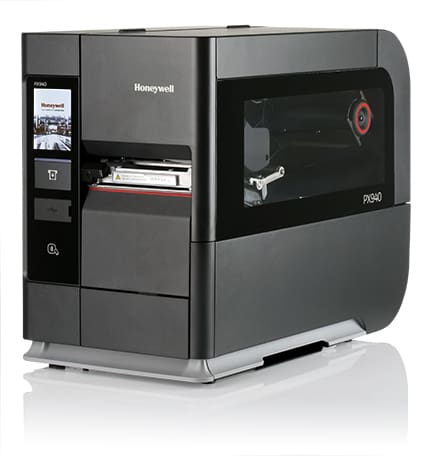
The Honeywell PX940 industrial printer with on-board verifier is a good example of this approach. It’s available in a version with an integrated verifier that checks each label immediately after printing, scoring barcodes against the ISO 15415/15416 verification standard and covering the major 1D barcode and 2D barcode symbologies used in manufacturing, healthcare, and logistics — Code 128, GS1-128, Data Matrix, QR Code, UPC/EAN variants, and more. The printer reports pass/fail status and an ANSI/ISO grade for every label, and because the verification engine is built into the print path, an operator gets immediate feedback rather than a batch result reviewed later.
The practical benefit of this model is speed of correction. If a printhead element starts to degrade, a ribbon wrinkles, or media tracking drifts, an inline verifier catches the defective label at the moment it’s produced — not after it’s already been applied to a shipment or, worse, after it’s already left the building. Many printer-integrated systems, including the PX940, can be configured to automatically reprint a label that fails verification, so a bad label never makes it into the production flow at all. For high-mix, made-to-order labeling — where labels are printed one at a time or in small runs as products move down a line — this closes the loop with essentially no added process step, since verification happens as part of printing rather than as a separate task someone has to remember to do.
The second approach uses a dedicated barcode verifier as a separate barcode quality control step, checking labels after they’ve already been printed — whether that’s immediately off a desktop or industrial printer, sampled from a high-volume production run, or checked after a pre-printed label has already been applied to a product.
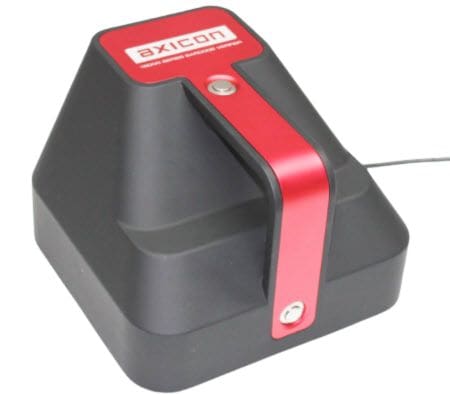
CSSI offers Axicon, a UK-based barcode verification specialist, as a well-known example of this model. Axicon’s verifiers are purpose-built, ISO/IEC 15426-conformant instruments — ranging from compact units for small point-of-sale barcodes up to larger models built for outer-case codes and combined linear/2D verification — that connect via USB and grade barcodes against the same ISO/IEC framework described above.
This standalone model earns its place in a few situations where inline printer verification isn’t practical or sufficient:
Very high-volume printing. When labels are being produced at high speed across multiple printers or print engines, checking every single label inline isn’t always realistic. A standalone verifier lets quality teams run statistically meaningful spot-checks across a production run, or fully audit a batch, without adding verification hardware to every printer on the floor.
Pre-printed labels and label rolls. Many operations don’t print their own barcodes at all — they receive rolls of pre-printed labels from a converter, or use pre-printed cartons and packaging. In these cases, there’s no printer in the loop to verify anything; a standalone verifier is the only way to confirm the barcode quality of incoming label stock before it’s applied to product.
Post-application checks. A barcode can pass verification the moment it’s printed and still be compromised by how it’s applied — wrapped around a curved surface, applied with air bubbles or wrinkles, or overprinted with variable data afterward. Checking barcodes after application catches defects that inline, at-the-printhead verification can’t see.
Incoming quality control and vendor audits. Companies that receive labeled goods or components from suppliers can use a standalone verifier to confirm vendor-supplied barcodes meet spec before they’re accepted into inventory — an increasingly common requirement in regulated and retail-compliant supply chains.
Standalone verifiers also tend to be the more flexible tool when a business needs to verify barcodes from more than one printer, more than one label converter, or more than one facility, since the verifier isn’t tied to a single print engine.
Which Barcode Verification Approach Is Right for Your Operation?
In practice, many operations end up using both models, applied where each makes the most sense — inline verification at the barcode printer for labels produced in-house, and standalone verification for incoming pre-printed stock, high-volume audits, or post-application spot checks. The right mix depends on print volume, how many printers and label sources are in play, and how far downstream unreadable barcodes have historically been discovered.
That’s a decision that benefits from someone who works with barcode label printing and verification across a range of environments — not just one printer line or one verifier model.
How CSSI Can Help with Barcode Verification
CSSI Technologies works with manufacturers, shippers, and distribution operations every day on exactly this kind of decision. As a barcode label printing expert, we can help you evaluate whether printer-integrated verification, standalone verification, or a combination of both fits your print volumes, label formats, and compliance requirements. We also supply and support reliable, high-quality industrial label printers (such as Honeywell’s PX940), independent verifiers such as Axicon, and high-quality label media and ribbon that verification results depend on in the first place, since even the best verifier can’t compensate for the wrong media-and-ribbon combination.
FAQ – Frequently Asked Questions About Barcode Label Verification
Q: What’s the difference between verification and just testing with a barcode scanner? A: canning only confirms that one particular barcode scanner can read the barcode under the conditions in front of it. Verification measures the barcode against ISO/IEC print-quality standards and produces a repeatable grade, so you know it will scan reliably on other equipment, in other conditions, over time.
Q: What barcode grade is considered a “pass”? A: Under the ISO/IEC 0–4.0 scale, 1.5 is the typical pass threshold for most retail and logistics barcodes (equivalent to a “C” on the older ANSI letter grade scale), while a lower threshold around 0.5 is often accepted for outer-case codes printed on corrugate.
Q: Do I need a barcode validator if my printer already prints clearly? A: barcode can look clean to the eye and still fail verification due to contrast, modulation, or decodability issues that aren’t visible without measurement. Verification is the only way to confirm scan reliability, independent of how the label looks.
Q: Can I verify barcodes on labels I didn’t print in-house? A: Yes — this is one of the main use cases for a standalone barcode verifier, which can check pre-printed label rolls, vendor-supplied labels, or barcodes after they’ve been applied to a product, regardless of what printer produced them.