Should You Use Vehicle-Mounted Computers or Rugged Tablets on Your Forklifts?
What is the Optimal Vehicle Computer for Your Operation?
Seeking to equip your forklifts or jockey trucks with computers? You’ll likely find yourself evaluating traditional fixed vehicle-mounted computers vs tablets. How to decide?
As discussed in the article “ Should I Be Replacing My Fixed Vehicle Computers with Grab-and-Go Rugged Tablets” , fixed-mount vehicle computers have been a supply chain and warehouse industry standard for many years, and have proven reliable and effective. However, ongoing improvements in tablet PCs justify their consideration as an alternative in some, but not all, situations.
We have taken a look at some of the primary differences and relative benefits between the 2 options for forklift applications.
Top Advantages of Vehicle Mounted Computers
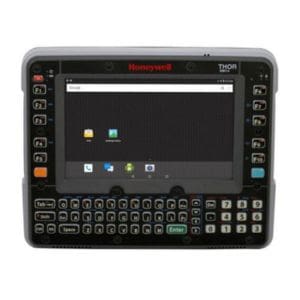
The most significant advantage of the vehicle-mounted computer is that it was purposefully designed to excel at the task of computing on a forklift or jockey truck. This means that it can tolerate vibrations and bumps, which may over time render less-rugged computers inoperable. A vehicle mount computer is powered directly from the vehicle battery, meaning the computer will be available for 24/7 use.
Also, a vehicle mount terminal can handle unique requirements, such as use within a freezer warehouse or refrigerated warehouse… special screens and screen defrosters will keep your forklift operator team on task. Also, special screens are available for use when users have gloved hands.
Long-term heavy usage tends to wear out commonly used components, such as keys and buttons. VMUs such as the Honeywell VM1A feature field-replaceable bezels, which enable you to swap out damaged keyboards without removing the computer from the forklift!
The purpose built computers are available with both Windows and Android operating systems.
Top Advantages of Rugged Tablet PCs
Portability is the most significant advantage of the rugged tablet PC when compared against a fixed-mount computer. Vehicle mount tablets can be docked on the forklift for typical mobile workflows, but can also be undocked and used independent of the vehicle. This can help the company reduce the number of devices required, as the tablet can replace the need for a separate handheld device.
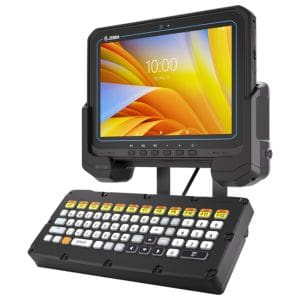
While traditionally tablets were not rated for forklift use, there are today tablets available which are certified for this purpose. For example, Zebra’s ET60 rugged tablet PC, which features a specially designed mount which absorbs vibration and protects connectors.
There are rugged tablet options available with both Windows and Android operating systems, and a ruggedized tablet can be configured with a keyboard when necessary.
Factors Which Tend to Advantage a Vehicle Mounted Computer
Tablets may be the best choice in light-duty warehouses, when LTE connectivity is needed, and especially when workflows will benefit from a device which can be removed from its mount and used independent of the forklift. However, there remain a number of factors which, if present, tend to favor vehicle mounted computers as the better choice:
Vehicles are always used within a wifi environment, and cellular access is not required
A keyboard interface is needed
The vehicle will operate in a freezer environment
The vehicle will experience extreme shock and vibration
The cost of switching out mounts and power harnesses would be extreme
Vehicles must be washed down with the mount system
CSSI Can Help You Choose Between Tablets and Vehicle Mounted Computers
The team at CSSI is very experienced with both vehicle mounted computers and rugged tablet PCs . We would be happy to have a conversation with you about your specific workflows and usage environment. Our team can help you select the ideal rugged devices, and schedule an on-site demo and trial period as well. Please contact CSSI to start a discussion of vehicle-mounted computers.
FAQ – Frequently Asked Questions About Deciding Between Vehicle-Mounted Computers (VMU’s) and Tablet PCs
Q: Do we need WiFi-only coverage or cellular (LTE) connectivity for our forklift fleet? A. This is one of the first questions to settle, because it often decides the answer on its own. If your operation runs entirely on warehouse WiFi, a vehicle-mounted computer is generally the simpler, more cost-effective fit. If forklifts move between buildings, yard areas, or sites without continuous WiFi coverage, a rugged tablet with LTE gives you connectivity a mounted unit can’t. Also consider CBRS / private cellular, which is an increasingly attractive option providing advantages for many larger facilities.
Q: Will these devices actually hold up in a freezer, cold storage, or washdown environment? A. Vehicle-mounted computers are purpose-built for these conditions, with defroster-equipped screens, gloved-hand touch compatibility, and washdown-rated housings available. Rugged tablets have closed some of that gap, but for continuous freezer operations or regular washdown protocols, a mounted system is still the more proven choice.
Q: What’s the real total cost of ownership, beyond the sticker price of the device itself? A. Look past the unit cost to the mounting hardware. Vehicle-mounted computers require a permanent mount and power harness, and replacing those after a collision or vehicle swap adds cost over time. Tablets use a docking and vibration-absorbing mount, which is typically less expensive to replace and lets the same device move between vehicles, potentially reducing how many units you need to buy in the first place.
Q: Can a rugged tablet really survive forklift-level vibration and shock? A. Standard consumer or light-duty tablets can’t, but purpose-built rugged tablets designed for vehicle mounting (such as the Zebra ET60) are now certified for this use when paired with a vibration-absorbing mount. For extreme shock and vibration environments, or applications where long-term durability under constant jarring is the top priority, a vehicle-mounted computer still has the edge.
Q: Do we have to standardize on one device type across the whole fleet? A. No. Many operations run a mixed fleet: vehicle-mounted computers on forklifts in freezer zones, washdown areas, or WiFi-only sections, and rugged tablets on units that need portability or LTE. Because the right choice depends on the specific forklift’s environment and workflow, CSSI evaluates each application individually and can set up a trial before you commit to either option fleet-wide.