The Differences Between Thermal Transfer and Direct Thermal Printers
Printer Technologies – How To Choose Between Thermal Transfer and Direct Thermal Label Printers
When selecting a label printing solution for your manufacturing facility or logistics operations, understanding the printing technology is just as important as the hardware itself. The two most widely used technologies for dedicated barcoding systems are Direct Thermal and Thermal Transfer printing. While both utilize a heated thermal printhead to create an image, their methods, durability, and ideal use cases differ significantly.
Here is a breakdown to help you choose the right printing technology for your barcode printing or receipt printing needs.
What Are the Core Differences Between Direct Thermal and Thermal Transfer Printers?
The fundamental difference between the two technologies lies in how the image is produced on the label:
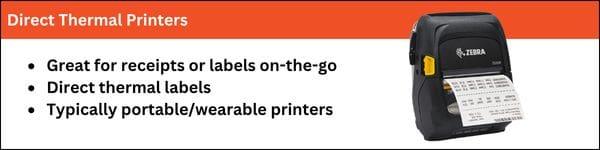
Direct Thermal Printing: This method uses chemically treated, heat sensitive paper. When the media passes under the heated printhead, the heat causes a chemical reaction that blackens the paper to create the image. It does not use a ribbon, ink, or toner.
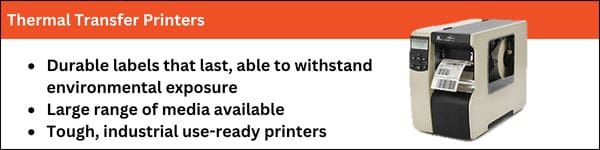
Thermal Transfer Printing: This technology requires a thermal transfer ribbon. The thermal printhead applies heat to a thin ribbon (coated in wax, resin, or a wax/resin blend), which melts the ink directly onto the label media to form a crisp, continuous image.
(Note: To determine if a specific media roll requires a ribbon, you can perform a quick “scratch test” on the label surface with a pen cap. If a black mark appears, it is Direct Thermal and needs no ribbon. If no mark appears, it is Thermal Transfer and requires a ribbon.)
Direct Thermal Printers: What Are the Advantages, Limitations, and Use Cases?
Direct thermal printers are celebrated for their simplicity and ease of use, as there is no ribbon to monitor or replace.
Direct Thermal Printer Advantages:
Simplicity & Lower Costs: Simple to operate with low long-term maintenance costs since there are no ribbons to replenish. Direct thermal print label material is less expensive.
Eco-Friendly & Efficient: Enables batch or single-label printing with virtually no waste. Recyclable material options are also available.
Print Quality: Direct thermal labels offer sharp print quality with excellent scanner readability for high-definition barcodes.
Direct Thermal Printer Limitations:
Environmental Sensitivity: Labels are highly sensitive to heat, direct sunlight (UV light), abrasion, and chemicals. Exposure causes the material to darken, rendering barcodes unreadable.
Short Lifespan: The paper remains chemically active after printing, meaning images may fade over time.
Typical Use Cases for Direct Thermal Printers: Direct thermal printers are best for short-term applications where the label only needs to last from one week to one year. Common applications include: • Shipping labels (perfect for Transportation & Logistics) • Receipts and picking tickets • Short-term compliance labels
Thermal Transfer Printers: What Are the Advantages, Limitations, and Use Cases??
Thermal transfer printing is the gold standard when you need extreme durability and archival-quality labels.
Thermal Transfer Printer Advantages:
Unmatched Durability: When matched with the right ribbon and media, labels are impervious to extreme temperatures, UV exposure, moisture, harsh chemicals, and abrasion.
Long-Lasting Image Stability: Thermal transfer labels produce crisp, glossy, high-definition text and graphics that will not rub off or fade over time.
Media Versatility: Can print on a nearly unlimited variety of media stock, including paper, polyester, vinyl, polypropylene, and polyimide.
Thermal Transfer Printer Limitations:
Higher Supply Costs: Requires the ongoing purchase of thermal ribbon supplies, which can be wasteful if little is printed on a single pass. Must factor in occasional print head replacement.
Compatibility Requirements: The ribbon and media substrate must be compatible. If mismatched, printhead heat could melt the ribbon onto the label and cause internal printer issues.
Typical Use Cases for Thermal Transfer Printers: Thermal transfer printers are ideal for demanding environments (like Manufacturing) and long-term storage. Common applications include: • Asset tagging and long-term inventory labeling • Chemical drum labeling • Component and specimen labeling (electronics or pharmaceuticals) • Outdoor labeling exposed to the elements
Feature Comparison: Thermal Transfer vs Direct Thermal Printers
Feature
Direct Thermal
Thermal Transfer
Ribbon Required?
No
Yes
Image Durability
Minimal resistance to heat, light, and chemicals.
Highly resistant to heat, light, abrasion, and harsh chemicals.
CSSI offers reliable and durable label and receipt printers from industry leaders such as Zebra Technologies. Our print experts can help with both thermal transfer and direct thermal printers, as well as print supplies such as label stock/print media, and print ribbons.
Contact CSSI to Discuss Label Printer and Receipt Printer Options
Our Zebra-certified printer experts at CSSI can help you evaluate your options and select both the right technology and best printer model for your application. Please contact us to discuss your printer needs.
FAQ – Frequently Asked Questions About Thermal Transfer vs. Direct Thermal Printers
1. What’s the easiest way to tell if a label roll is direct thermal or thermal transfer? Run a pen cap or fingernail across the label surface with light pressure. If a black mark appears, it’s direct thermal (heat-sensitive coating). If nothing shows up, it’s thermal transfer, and it will need a compatible ribbon to print.
2. Do direct thermal printers really need no ribbon at all? Correct. Direct thermal printing uses chemically treated, heat-sensitive paper — the printhead’s heat triggers a reaction that darkens the label to form the image. There’s no ribbon, ink, or toner involved, which keeps the printer simpler to run and lowers long-term consumable costs.
3. How long will a direct thermal label actually last before it fades or becomes unreadable? Direct thermal labels are best suited for short-term use, generally from one week up to about a year. Because the paper stays chemically active after printing, exposure to heat, direct sunlight, abrasion, or chemicals can darken the material further and make barcodes unscannable. That makes it a strong fit for shipping labels, receipts, and picking tickets, but not for anything that needs to survive long-term storage or harsh conditions.
4. Why would a business pay more for thermal transfer printing instead of just using direct thermal? Thermal transfer trades a lower per-label cost for durability. Because a wax, resin, or wax/resin ribbon melts ink onto the label, the resulting image resists extreme temperatures, UV exposure, moisture, chemicals, and abrasion — and it won’t fade over time the way direct thermal can. It also prints on a much wider range of materials, including polyester, vinyl, polypropylene, and polyimide. For asset tags, drum labels, or outdoor/industrial labeling that has to last, the added ribbon cost is usually worth it.
5. What happens if I use the wrong ribbon with thermal transfer media? Ribbon and label material have to be compatible. If they’re mismatched, the printhead’s heat can melt the ribbon directly onto the label instead of transferring it cleanly, which can gum up the printhead and cause internal printer problems. This is why it’s worth confirming ribbon/media compatibility (or working with a printer specialist) before running a new combination through the printer.