Beyond the Single Line: Why Are 2D Barcodes the Backbone of Modern Supply Chains?
A barcode symbology guide for warehouse, distribution, and logistics operations
Walk the floor of virtually any modern distribution center, and you’ll find barcode labels on everything—cartons, pallets, bin locations, and assets of every kind. But look closely, and you’ll notice something: not all barcodes look the same. Some are simple black-and-white stripes. Others look like tiny crossword puzzles or geometric mosaics. That distinction matters—a lot.
This post breaks down the difference between 1D and 2D barcode symbologies, explains why 2D has become the preferred choice for high-volume operations, and highlights the three 2D code formats you’re most likely to encounter in warehousing, transportation, and distribution. The typical modern barcode scanner can handle both formats, so you should understand each to choose the best barcode type for your business application.
What Are the Key Differences Between 1D and 2D Barcodes?
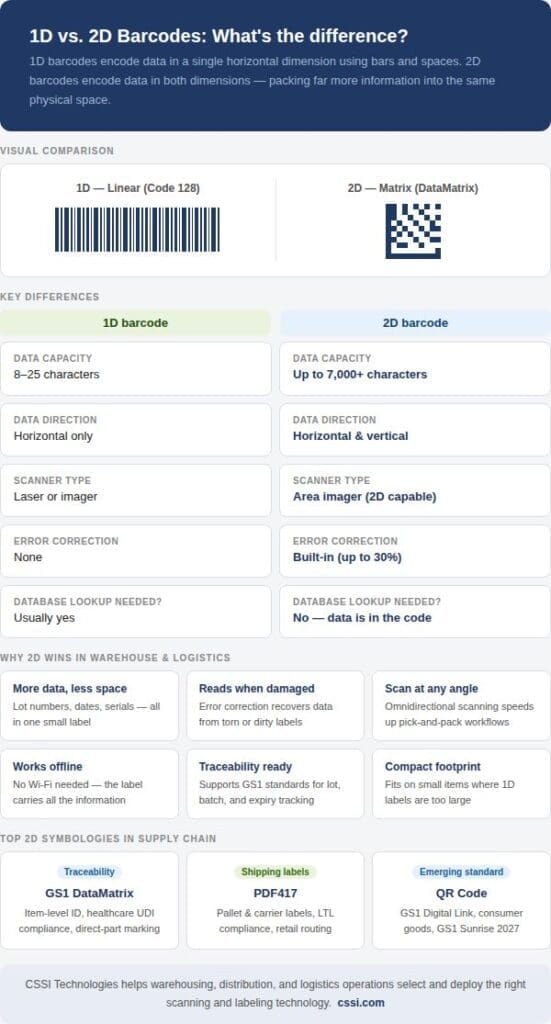
1D Barcodes: Simple, Linear, and Limited
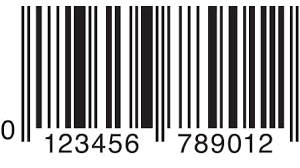
The classic barcode—officially called a 1D or linear barcode—encodes data in a single horizontal dimension using a series of parallel bars and spaces of varying widths. When a 1D barcode scanner reads it, it captures information in a single sweep from left to right.
Common 1D symbologies include Code 39, Code 128, UPC-A, and ITF-14. Most people are familiar with the universal product code (UPC code). These formats have been workhorses of commerce and industry for decades, and for good reason: they’re simple to print, easy to scan, and universally supported. But they carry a significant limitation—capacity. A typical 1D barcode can hold anywhere from 8 to 25 characters of data, just enough for a part number, serial number, or SKU. The 1D scanner tends to be the simplest (and cheapest) barcode scanner available.
That constraint forces a tradeoff: the barcode itself becomes just a pointer, a key that unlocks a record in a back-end database. If the scanner can’t reach that database (poor connectivity, system downtime, edge locations), the data is effectively inaccessible.
2D Barcodes: Data in Two Dimensions
2D barcodes encode data in both the horizontal and vertical dimensions, using patterns of dots, squares, or other shapes arranged in a matrix or stacked rows. The result is dramatically higher data capacity.
Where a 1D barcode might store a 12-digit product number, a 2D barcode label can carry hundreds—or even thousands—of alphanumeric characters in the same physical footprint. That means the barcode itself can contain rich data: lot numbers, expiration dates, serial numbers, URLs, shipping instructions, and more—all without a database lookup. Typicallys, a 2D scanner can also be used to read a 1D code.
What Are the Advantages of 2D Barcode Labels?
The move from 1D code to 2D code isn’t just about more data. It unlocks a range of operational advantages that matter greatly in demanding supply chain environments.
Higher Data Capacity
This is the headline benefit. 2D barcodes can encode structured data strings—GS1 Application Identifiers, product details, date codes, batch numbers—within a single label. For industries like food & beverage, pharmaceuticals, or electronics, where traceability requirements are strict, this is transformative.
Smaller Footprint
Because barcode data is encoded in two dimensions, 2D symbols can be printed much smaller than their 1D equivalents while still holding more information. This is critical in applications where label real estate is limited, such as small components, medical devices, or individual item labels on consumer packaged goods.
Error Correction
Most 2D symbologies incorporate built-in error correction algorithms (Reed-Solomon is common). This means that even if a portion of the 2D barcode is damaged, dirty, or obscured, the scanner can still reconstruct and decode the data accurately—a significant advantage in harsh warehouse and manufacturing environments where labels take a beating.
Omnidirectional Scanning
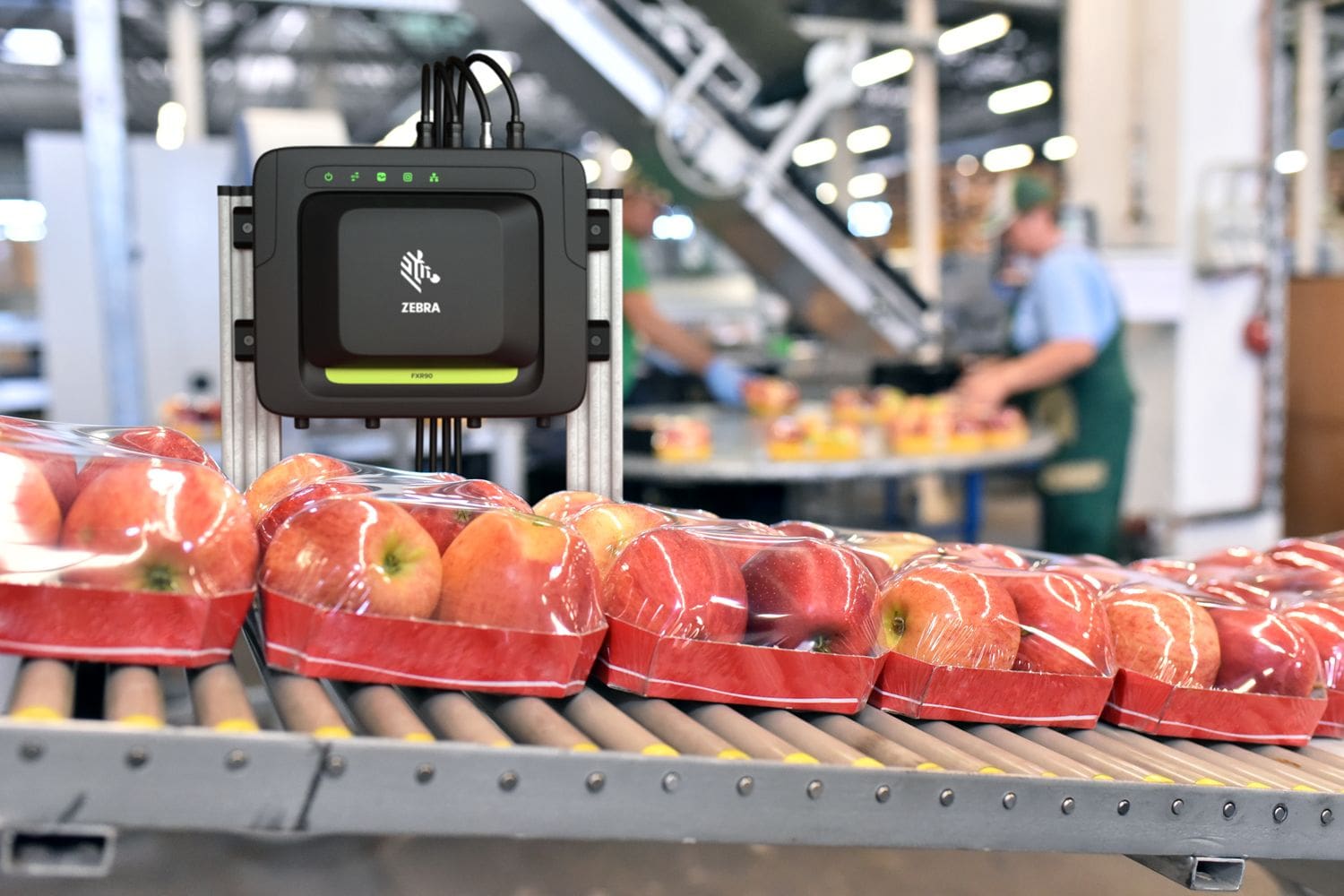
2D barcodes can be read from any orientation—upside down, sideways, at an angle. This improves scan rates and reduces operator frustration, particularly on high-speed conveyor lines or in pick-and-pack operations where workers are moving quickly.
Offline Data Availability
Because the barcode carries the data itself (rather than just a pointer to a database), 2D barcodes support offline workflows. Scanners in areas with limited Wi-Fi coverage—cold storage, loading docks, remote yard locations—can still capture complete, actionable information without a network connection.
Image-Based Scanning Compatibility
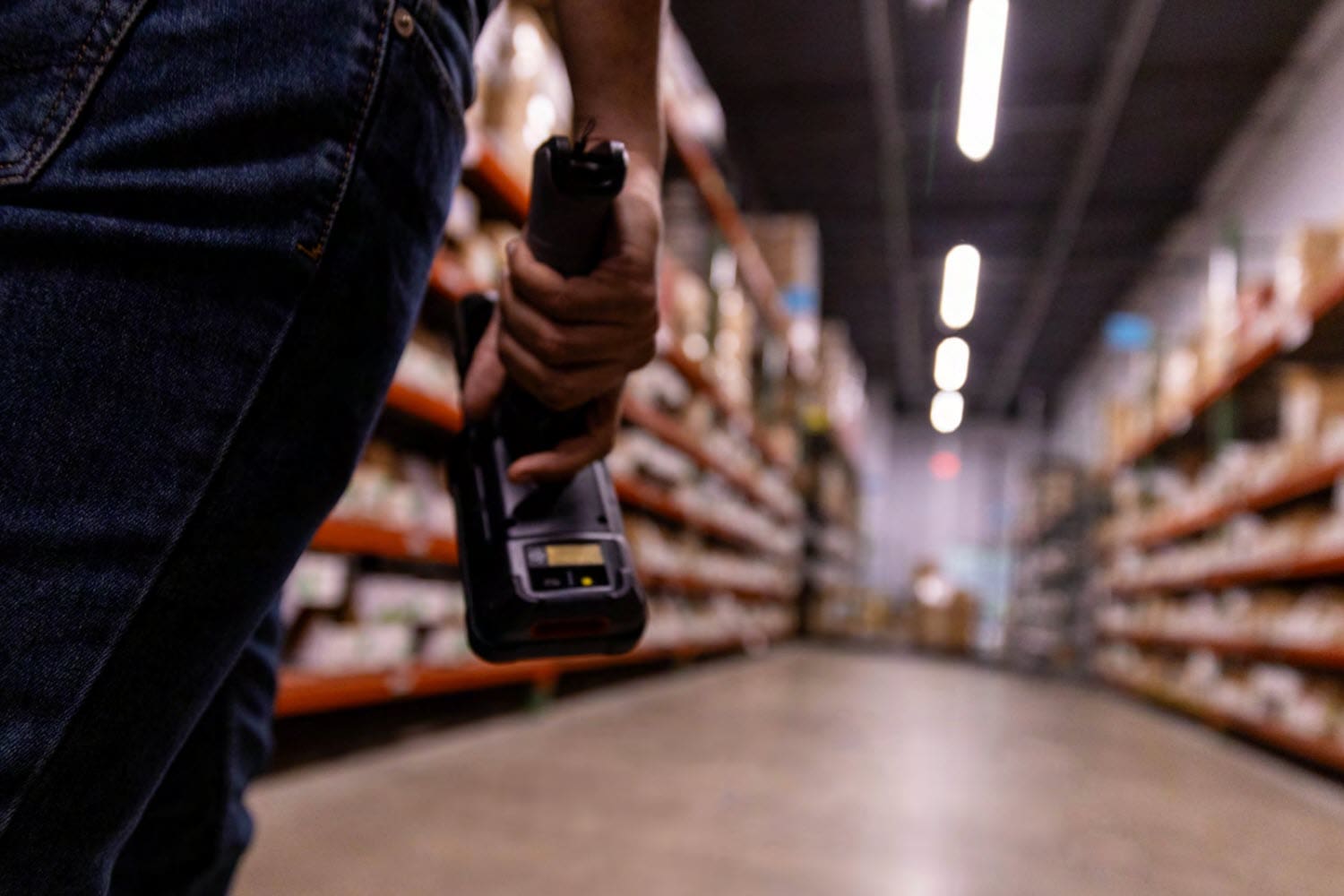
2D barcodes require image-based (area imager) scanners rather than laser scanners. This is actually a feature, not a limitation: modern area imagers can read 1D and 2D codes, capture photos, and even read damaged or poor-quality labels with sophisticated decode algorithms. The technology has matured to the point where area imagers are now the standard choice for new deployments.
What Are the Top 2D Barcode Symbologies in Warehouse, Transport & Distribution?
There are dozens of 2D barcode standards in existence, but three dominate in supply chain and logistics environments. Here’s what you need to know about each.
1. GS1 DataMatrix
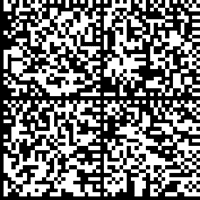
Data Matrix is a compact, square 2D symbol built around the GS1 system of standards—the same framework that governs UPC and EAN barcodes in retail. In supply chain applications, GS1 DataMatrix is the go-to format for item-level identification, particularly in regulated industries.
Key characteristics of Data Matrix barcodes:
Encodes GS1 Application Identifiers (AIs) for structured data: GTINs, lot numbers, expiration dates, serial numbers
Highly compact—can be printed very small, down to direct-part marking on metal components
Excellent error correction (up to 30% of the symbol can be damaged and still read successfully)
Widely used in healthcare (FDA UDI compliance), food & beverage traceability, and electronics manufacturing
If your operation handles items where regulatory traceability is required—or where individual item serialization is part of your workflow—GS1 DataMatrix is likely already in your supply chain.
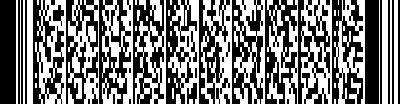
2. GS1-128 / PDF417 (Stacked Linear)
PDF417 is a stacked barcode symbology—technically a bridge between 1D and 2D—that arranges multiple rows of linear code into a tall, rectangular symbol. It’s been a staple in transportation and logistics for decades.
Key characteristics:
High data capacity: up to 1,800 numeric or 1,100 alphanumeric characters
Supports the ANSI MH10.8.2 and GS1 standards used in shipping labels
Widely used on bill of lading labels, pallet labels, and government ID documents (driver’s licenses in North America use PDF417)
Readable with standard linear barcode scanners at moderate print quality
PDF417 remains common on UPS, FedEx, and LTL carrier shipping labels, and on GS1-128 pallet labels compliant with retailer compliance programs (Walmart, Target, Amazon, etc.). If you’re managing outbound compliance labels today, there’s a good chance PDF417 is already part of your label set.
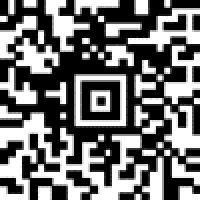
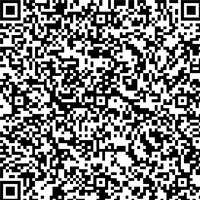
3. QR Code
Originally developed by Denso Wave for automotive parts tracking in Japan, the QR code has become the most widely recognized 2D symbology in the world—and it’s increasingly finding serious application in supply chain operations beyond its consumer-facing uses.
Key characteristics:
High capacity: up to 4,296 alphanumeric characters or 7,089 numeric characters
Four levels of error correction, making it resilient in dirty or physically demanding environments
Open, royalty-free standard with enormous ecosystem support
The GS1 Digital Link standard now enables QR codes to carry structured supply chain data (GTINs, lot numbers, expiration dates) in a URL-compatible format
GS1’s recent push toward the “Sunrise 2027” initiative—an industry milestone where retail point-of-sale systems are expected to be capable of scanning GS1 Digital Link QR codes—is dramatically accelerating QR adoption in consumer goods and retail supply chains. For warehouse operations that handle CPG products, QR is increasingly becoming a format you need to be ready to read.
The Bottom Line on 1D vs 2D Barcode Symbologies
The shift from 1D to 2D barcode labels isn’t a trend—it’s already well underway across the supply chain. Driven by traceability mandates, compliance requirements, and the demand for richer data at every node of the supply chain, 2D symbologies offer capabilities that linear barcodes simply can’t match.
For operations managers and IT leaders evaluating barcode scanner hardware, barcode label printing systems, or WMS integrations, understanding which 2D barcode formats your trading partners, carriers, and regulatory bodies require—and ensuring your equipment is capable of reading and printing them—is no longer optional. It’s table stakes.
The good news: modern rugged mobile computers and barcode scanners from manufacturers like Zebra Technologies, Honeywell, and Datalogic support all major 2D symbologies out of the box. The technology is ready. The question is whether your operation is configured to take full advantage of it.
Questions about the different types of barcodes, your barcode scanner infrastructure or barcode label printing capabilities? CSSI Technologies helps warehousing, distribution, and logistics operations select, deploy, and support the right AIDC solutions. Contact us for barcode technology and support at cssi.com.
FAQ – Frequently Asked Questions About Using 2D Barcode Symbologies in Warehouse and Distribution
1. What equipment do I need to read 2D barcodes in my warehouse? You’ll need area imager scanners (also called 2D imagers) rather than traditional laser scanners. Modern rugged mobile computers and handheld barcode scanners from manufacturers like Zebra Technologies, Honeywell, and Datalogic come 2D-capable out of the box and can read both 1D and 2D symbologies. If your current devices are laser-only, a hardware refresh is worth evaluating — the scanning performance and data capture advantages of 2D imagers typically deliver a strong ROI.
2. Will 2D barcodes work in areas of my facility with poor Wi-Fi coverage — like cold storage or loading docks? Yes — and this is one of the key advantages of 2D barcodes. Because the barcode itself contains the data (lot numbers, serial numbers, expiration dates, and more), your workers don’t need a live database connection to capture complete, actionable information. This makes 2D particularly well-suited to edge locations like freezers, outdoor yards, and dock doors where wireless connectivity can be unreliable.
3. Which 2D barcode format should I use — DataMatrix, PDF417, or QR? It depends on your use case. GS1 DataMatrix is the preferred choice for item-level traceability, especially in regulated industries like food & beverage or healthcare. PDF417 is the standard for pallet and shipping labels used by major carriers (UPS, FedEx) and retail compliance programs. QR Code is gaining ground in consumer goods supply chains, driven by the GS1 Sunrise 2027 initiative. In many operations, you’ll encounter all three — so ensuring your scanners can read each format is the practical priority. Consult with CSSI for advice on choosing a symbology.
4. Can I print 2D barcodes on my existing label printers? Most modern thermal transfer and direct thermal label printers support 2D barcode symbologies natively through their firmware and printer command languages (ZPL for Zebra, IPL/DPL for Datalogic/Intermec, and others). If your printers are relatively current, you likely already have 2D printing capability. Older hardware may require a firmware update or replacement. Your labels also need to be printed at sufficient resolution (typically 203 dpi minimum, 300 dpi preferred) to ensure reliable scanning, particularly for compact DataMatrix symbols.
5. Do I need to change my WMS or ERP system to support 2D barcodes? Not necessarily — but some configuration will likely be required. The scanning hardware and label formats can often be updated independently of your back-end systems. However, to take full advantage of 2D’s data capacity (capturing lot numbers, expiration dates, and serial numbers in a single scan), your WMS or ERP needs to be configured to receive and process that structured data. An experienced AIDC integrator like CSSI can help assess your current system’s readiness and identify what changes — if any — are needed to unlock the full value of 2D.