
Time To Move On from Microsoft Access?
For many businesses, Microsoft Access has been a quiet workhorse — handling inventory records, customer data, job tracking, or order management for years, sometimes decades. It was the right tool at the right time. But in 2026, that same database that once solved a problem may now be creating new ones. At CSSI Technologies, we work with companies across warehousing, distribution, and manufacturing who rely on legacy Access systems to run key business functions — and we have seen firsthand what happens when those systems start to hold an organization back.
Why So Many Companies Chose Access in the First Place
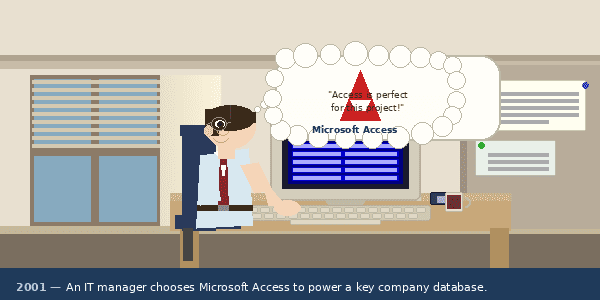
There is nothing wrong with the original decision. When businesses first adopted Microsoft Access — often in the late 1990s or early 2000s — it was a genuinely powerful and accessible tool. It required no dedicated database server, no specialized IT infrastructure, and no large capital investment. A capable office administrator or tech-savvy manager could build a functional database application without being a professional developer.
Access shipped as part of Microsoft Office, which meant most businesses already owned it. It offered a visual form designer, report builder, and query tools that felt intuitive compared to the alternatives. For small to mid-sized operations with a limited IT budget, it was the practical choice — and for years, it worked well.
The problem is not that those companies made a poor decision. The problem is that business technology has evolved dramatically, and Access has not kept pace.
The Shortcomings of Access in Today’s Business Environment
If your company is still running critical processes on Microsoft Access, you have likely encountered one or more of the following challenges:
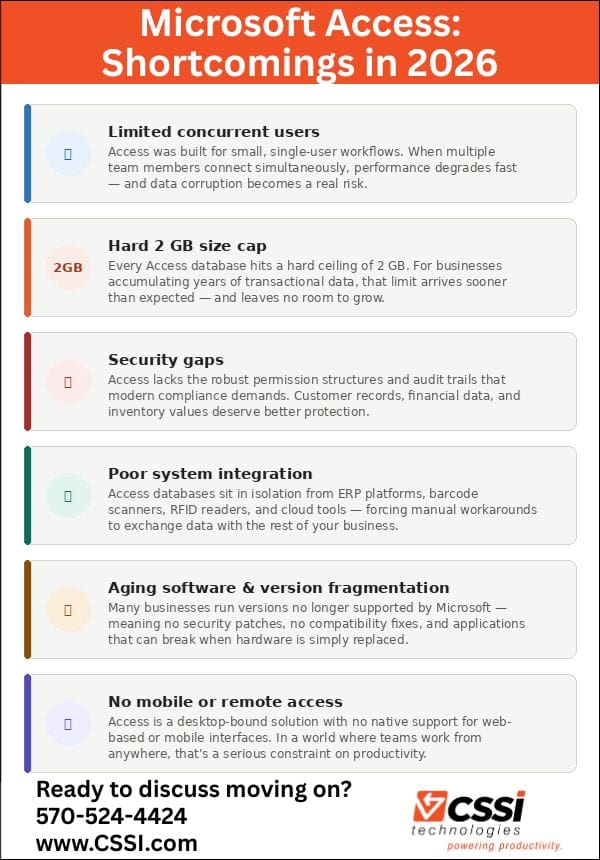
- Limited concurrent users. Access was designed for small teams. When multiple users try to access the same database simultaneously, performance degrades quickly — and data corruption becomes a real risk. As your team grows or your data volumes increase, this becomes a serious operational liability.
- Scalability constraints. Access databases are capped at 2 GB in size. For businesses with years of transactional data, that ceiling can be reached faster than expected. Once there, the only options are to archive data or accept degraded performance.
- Security limitations. Access offers basic user-level security, but it falls well short of the robust permission structures and audit trails that modern compliance requirements demand. Sensitive data — customer records, financial transactions, inventory values — deserves better protection than Access can reliably provide.
- Poor integration with modern systems. Today’s business environment runs on connected systems: ERP platforms, warehouse management software, barcode scanners, RFID readers, and cloud-based tools. Access databases often sit in isolation, requiring manual data entry or custom workarounds to exchange information with other platforms.
- Aging software and version fragmentation. Many of our customers are running versions of Access that are years or even decades old. Older versions are no longer supported by Microsoft, meaning no security patches and no compatibility with current hardware or operating systems. Even simple IT upgrades — like moving to a new PC — can break an aging Access application.
- No mobile or remote access. The modern workforce expects to access data from anywhere. Access is a desktop-bound solution, with no native support for web-based or mobile interfaces without significant custom development.
How CSSI Technologies Can Help
As custom programming experts, the folks at CSSI understand that migrating away from a system your team has relied on for years is not a decision made lightly. There are real concerns about cost, disruption, and the risk of losing institutional knowledge embedded in your current workflows. That is exactly why CSSI approaches every Access migration with a practical, consultative lens — not a one-size-fits-all prescription.
We typically recommend one of three paths, depending on your specific situation, budget, and long-term goals:
Option 1: Upgrade to the Current Version of Access
For organizations running very old versions of Access, a targeted upgrade can deliver meaningful improvements without the complexity of a full migration. Modern versions of Access offer better performance, improved compatibility with current operating systems, and enhanced security features compared to legacy releases. CSSI can help with Access migration services. This is the lowest-disruption option and can serve as a stabilizing step while your organization plans a longer-term strategy.
Option 2: Move Your Data to a Robust Database Engine, Keep Your Access Front End
This is often the best option for companies that have invested significantly in Access forms and reports that their team knows well. We migrate your stored data from the Access file to a professional database platform such as Microsoft SQL Server, while retaining the familiar Access interface your team already uses. You gain the scalability, security, and reliability of SQL Server on the back end, with minimal retraining required on the front end. It is a pragmatic middle path that delivers substantial improvements without forcing a complete workflow change.
Option 3: Rebuild the Solution from the Ground Up
For organizations that have outgrown Access entirely — or whose business processes have evolved beyond what any version of Access can support — a full rebuild is the right answer. CSSI can design and develop a modern application using current programming languages and a robust database such as Microsoft SQL Server. This approach opens the door to mobile access, deeper integration with your other business systems, custom reporting, and the scalability to grow with your business for years to come. While it represents the most significant investment of the three options, it is also the one that delivers the most transformative long-term value.
Is It Time to Have a Conversation About Your Access Use?
If your organization is running important business processes on Microsoft Access — and especially if you are doing so on an older version of the software — now is the right time to take an honest look at your options. Waiting until a failure forces your hand is far more costly than making a planned, strategic transition.
CSSI Technologies has the experience to help you evaluate your current Access environment, understand your business requirements, and identify the migration path that makes the most sense for your organization. We are not here to sell you the most complex solution — we are here to help you make the right one.
Reach out to the team at CSSI Technologies today. Tell us how you are currently using Access, what pain points you are experiencing, and what you would like your system to do that it cannot do today. We will work with you to map a practical path forward — one designed around your operations, your budget, and your goals.
Contact CSSI Technologies at cssi.com to start the conversation.