Tag Archive for "Microsoft GP"
How to Use Advanced Lookups in GP

Create Extra Sorting & Lookup Options in GP

Did you know that in GP, you can add extra sorting and lookup options for a user to access quickly without needing to go into Custom Sort?  Advanced lookup fields are available on 14 Lookup windows, and you can add up to 4 additional fields.

We’ll use Customer Lookup for example.   Go to the Customer Maintenance Window (Sales > Cards > Customer).  Select the Lookup icon to go to the Customers and Prospects window.

On the Customers and Prospects window select the down arrow next to Additional Sorts.

This will display the current sort options available.

The next step is to add a “by Custom Sort”.  Find the setup for Additional Sorts by going to Microsoft Dynamics GP > Tools > Setup > Company > Advanced Lookups.  This will open the Advanced Lookups Setup window.  Select the Lookup Name to be modified.

Select the Field(s) you would like to add as a “Sort by” option.  The description is editable so you can change the description.  Note below where the field User Defined 1 has had the description changed to be more meaningful.  Save the changes made to the lookup.

The next time you go to the Customer lookup window, the Additional Sorts will be available for use.

Need GP Support?

CSSI is available to help with your GP technical support and training needs. We can assist with GP upgrades, customizations, enhancements, trouble-shooting, and report writing. Please contact us for GP help.

Verifying Vendor Tax ID’s & Employee Social Security Numbers

This is not exclusively for GP users but a helpful tip for anyone who files 1099 and W-2 forms. The IRS and the Social Security Administration (SSA) both offer free online tools for taxpayers (payers/employers) to validate taxpayer identification numbers and social security numbers.

You can access these tools from the IRS website below.

Taxpayer identification number (TIN) matching tools | Internal Revenue Service

Why This Matters: Risks of Not Verifying Payee Data

Without proper verification:

  • Names and TINs may not match IRS/SSA records, triggering backup withholding, filing rejects or errors, or penalties.
  • Employees might not get correct credit for their earnings if W-2s are wrong (wrong SSN/name).
  • You may need to file corrections (e.g., 1099-Corr, W-2c), which is time-consuming, and potentially subject you to late-filing penalties.

Need GP Support?

If you need help with GP, please contact the GP experts at CSSI Technologies. We’d be glad to help with general GP support, upgrades, and report creation.

How to Allocate Inventory to Multiple Bins In GP

Did you know that Microsoft Dynamics GP provides the ability to track inventory quantities in more than one bin location within a site/warehouse?  By default, GP lets you set up one “default” bin per item/site, but if you need more detailed tracking—such as stock spread across aisles, shelves, or zones—you enable Multiple Bins in the Inventory Control module.
 
You can then assign default bins for different types of transactions for each item/site combination.

The Bin Quantity Inquiry window lists all the bins containing quantities for a particular item.

This does add an extra step to each inventory-related type of transaction because GP now must track not just what site an item is in, but also which bin(s) it is stored in. There are certain steps that need to be followed when you enable this feature. 

Need GP Support for Inventory Management?

If you’re looking to improve your inventory management, CSSI offers a warehouse management software solution (WMS) specifically written for GP users. For help with WMS or inventory management, please contact CSSI to discuss.

Understanding GP’s Multidimensional Analysis Feature

MDA is a feature in Dynamics GP that lets you “tag” transactions with additional “dimensions” for reporting and analysis. 
 
For example, instead of creating a new GL account for every department, region, project, cost center, product line, etc., you can use MDA codes to capture these extra details and keep a streamlined chart of accounts.
 
First you define your MDA Groups and the Codes that will be used within each group.

Next, you link your MDA groups to G/L accounts. You can indicate whether you would also like to track quantities (in addition to dollars). Analysis Types are Fixed, Required, Optional or None. You can enter default percentages to be applied to transaction distributions for each code, which can be overwritten in the transaction. A single G/L account can have multiple MDA groups assigned.

When a G/L account, that has MDA groups assigned, is used in a transaction, the Account Analysis button becomes available (circled below).

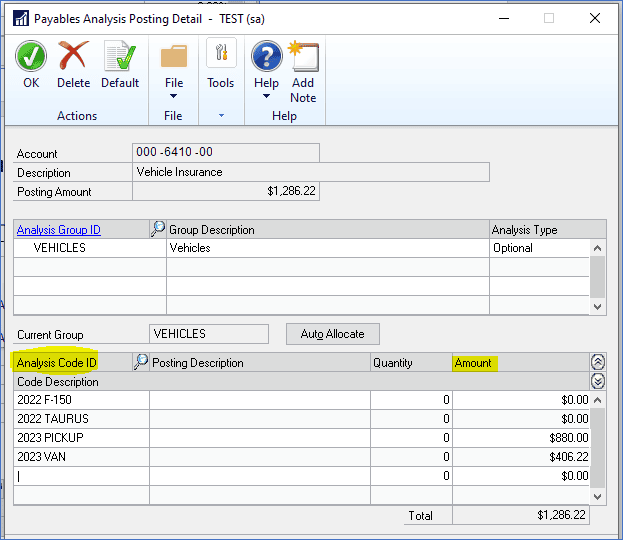
Click on the Account Analysis button to open the Analysis Posting Detail window where you can distribute the transaction amount to MDA codes.

MDA transaction history can be viewed in the Account Analysis report, Analysis Inquiry window and in SmartLists.

MDA codes can be used in the following transaction types:

  • General Journal Entry
  • Payables Transaction Entry
  • PO Receiving
  • PO Invoice Entry
  • Receivables Transaction Entry
  • Sales Invoicing
  • Sales Transaction Entry

Need a Great GP Support Partner?

Are you in need of a responsive and knowledgeable GP support partner? CSSI provides helpful technical support, training, and upgrade help. Contact us to discuss how we can help you manage your use of Dynamics GP.

Sales Order Deposits and Down Payments in GP

In this article we discuss how to handle sales order deposits and down payments in GP.

Use the Amount Received field in a Sales Order to record a customer deposit/down payment.
 
You will first need to assign a default Deposits Received account by going to Microsoft Dynamics GP > Tools > Setup > Posting > Posting Accounts.  Change the Display to Sales.

In Sales Transaction Entry, enter the deposit amount in the Amount Received field.

When you tab off the Amount Received field, the Sales Payment Entry window will open. Select a payment Type and a Checkbook ID. The Check Number field will be available for the “Check Deposit” type.

When you save the sales order, and close the Sales Transaction Entry window, a journal entry will be created to debit cash and credit customer deposits. This payment will then appear in the Bank Deposits Entry window to be included on a deposit.

When the order gets transferred to an invoice, and posted, the customer deposits GL account will be debited in the amount of the payment. The amount that debits Accounts Receivable will be the document total amount less the deposit amount received.

The sales order and invoice documents can be modified to display the payment received as shown in the example below.

Need Help with GP?

CSSI Technologies provides expert support for Dynamics GP. We offer technical support, training, upgrades, and more. Please contact us for GP help.

GP Tip: Editing an A/P Transaction After Posting

Did you know that Dynamics GP allows you to edit certain fields after an AP transaction has been posted? You can do so by going to Purchasing > Transactions > Edit Transaction Information.  Select a Vendor ID and a Document Number.

The following fields are available to be changed:  Remit-To ID, Discount Date, Due Date, P.O. Number and Description.

Need Microsoft Dynamics GP Technical Support?

If you need help with GP (training, tech support, upgrades, customizations), please contact the GP experts at CSSI. We’d be glad to help!

Creating a List of Unreconciled Bank Transactions in Dynamics GP?

Here is an easy way to create a SmartList of unreconciled Bank Transactions. Go to Microsoft Dynamics GP > SmartList. In SmartList, navigate to Financial > Bank Transactions. Select the option with the asterisk.

Click on Columns and then the add button to add the columns that you would like to appear in the SmartList. Click OK when you are finished.

Next, click on the Search icon. Add the restrictions to the SmartList. Set the checkbook ID equal to your checkbook ID, set Voided equal to no and set Reconciled equal to No. Then click OK.

This will give you the list of unreconciled transactions. Click on Favorites and give your report a name. Then click Add > Add Favorite.

Contact CSSI for GP Technical Support and Training

For GP help and training, please contact CSSI. Our team of experts stand by to assist!

Have you ever had the need to print a trial balance containing non-sequential account numbers?  Say you would like to see a GL Trial Balance detail for just a couple of main segment account numbers, but do not want to see all the accounts in between. 

Here is an example.  We need to see GL detail for accounts containing 6100 and 6520 as their main segments.  But we do not want to see any other accounts on our report. 

You can create this custom report using the GL Trial Balance and GL Navigation Lists!

1. Go to the Financial page

      2. Click on Accounts in the Navigation pane and wait for your accounts to list

      3. Click on Add Filter

      4. Enter your first filter then click on the down arrow to the right of the second Add Filter and select the “Or” condition

      5. Add your second filter then click on the arrow circled below to Apply Filter

      6. The filtered account list will appear

      7. Select the accounts to be included on the report.  Select all reports by checking the checkbox on the header row.

        8. Click on the down arrow under Reports and select Print Trial Balance

        9. Choose whether you want to Include Details.  Select the Year then click on Print.

        10.  You can save the filter list for future use.  Click on Accounts (read only) at the top of the screen and select Save As

        11.   Type in a name and click on OK

        12.  The new list will now on the Financial Navigation pane under Accounts

        Note:  Navigation lists are available for all GP modules.

        That’s it!

        Need GP Training or Support?

        CSSI offers experienced GP experts who are available for training, technical support, and upgrades. Please contact CSSI to discuss your GP needs.

        Printing Separate Checks to Vendors, One Check Per Invoice

        Have you ever had the need to print separate checks to one vendor, one check per invoice?  GP provides three different options for doing this.

        1. If you want to always print one check per invoice for this vendor, go to Vendor Maintenance, select the Vendor, click on Options, and changed the setting highlighted below.

        2. If you use the Build Payment Batch window, there is a “One Payment Per” option.  You can select Use Vendor Option, which will look at each vendor’s option shown in method # 1 above.  Or you can select “Invoice”, which will create one payment per invoice (for all vendors in this “Build”).

        3. Use different Remit To address IDs in AP invoices.  When you enter an invoice in Payables Transaction Entry, you can change the Remit-To ID.  Each Remit-To ID will receive a separate check.  For example, if you enter three AP invoices for the same vendor, with each invoice containing a different Remit-To ID, then that vendor will receive three checks.

        That’s it!

        Need Dynamics GP Support?

        Do you need technical support or training with Dynamics GP? Contact the GP experts at CSSI for help.

        2024 General Ledger Year-End Closing

        Have you run your GL year-end closing routine yet?  Here is a refresher on what this process does.

        • Closes all Profit and Loss (P/L) account balances into Retained Earnings account(s)
        • Balance Sheet account balances are rolled forward to the new year by having Balance Brought Forward (BBF) entries created. 
        • All open General Ledger records (GL20000) are moved to the historical table (GL30000).
        • Inactive General Ledger accounts without a balance and no historical transactions are removed if you are not ‘maintaining’ inactive accounts.
        • The Year that was just closed is marked as historical.

        Even though you have closed the year, you can still post to that year.  GP allows you to post back to the last closed year.  Just be sure your Financial module is open in Fiscal Periods Setup (Microsoft Dynamics GP > Tools > Setup > Company > Fiscal Periods).

        GP also allows you to reverse a year-end closing.  When you reverse a historical year, the original Balance Brought Forward (BBF) journal entry gets removed from the system.  Then when the year is re-closed, a new BBF entry is created.  Once the year is re-opened, this allows you to post adjustments in the GL and when ready, you can re-close the year.

        Need GP Support?

        The GP experts at CSSI are available if you need support or training. Please contact us to discuss.